Viscous Heat Backflow and Temperature Resonances in Extreme Thermal Conductors [PRL 136, 186302]
This work explains how viscous heat phenomena in layered materials can be induced, controlled, and amplified, opening new avenues for managing and engineering thermal signals in technologies ranging from conventional electronics to heat-based neuromorphic computing.
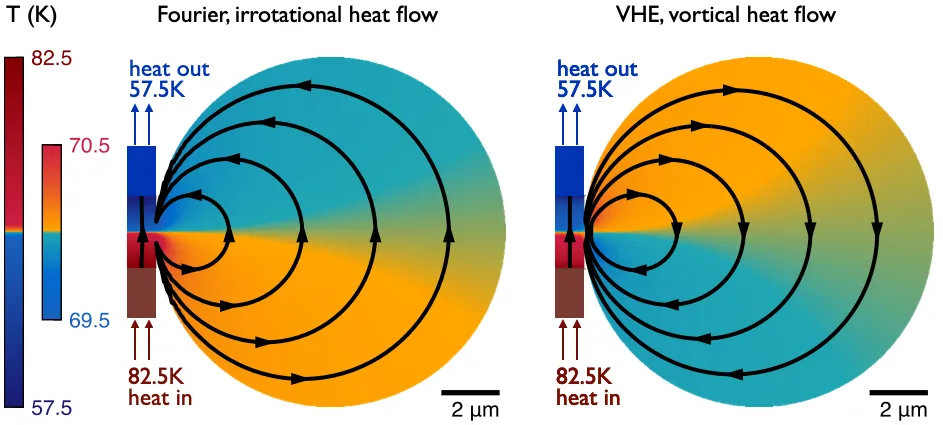
Using quantum-accurate simulations, we parametrize a set of mesoscopic viscous heat equations, i.e., the thermal counterpart of the Navier-Stokes equations in the laminar regime, and predict that viscous heat flow emerges and features smoking-gun signatures such as vortices in a device with circular geometry. We also show that when these materials are heated for a very short time, their temperature relaxes to equilibrium in an oscillatory way, reminiscent of waves in a fluid. We discuss how these temperature waves can be amplified by exploiting resonance, and how they are damped by a "heat viscosity" that we quantitatively predict from quantum-mechanical simulations.
Overall, we demonstrate that the physics of heat transport in layered materials shares fundamental analogies with fluid dynamics and can even mimic neuronal transfer functions, ultimately suggesting that heat is not always a nuisance but can also be leveraged as a signal.
Image caption: Heat is vertically injected at the boundary of a graphite device. The viscous nature of heat generates vortices that cause thermal energy to backflow from cooler blue regions to warmer red regions, yielding a temperature profile opposite to the Fourier prediction shown in the left panel.
link to press release: https://quantum.columbia.edu/news/how-layered-crystals-make-heat-swirl
link to scientific article: https://journals.aps.org/prl/abstract/10.1103/nbbn-56hr